

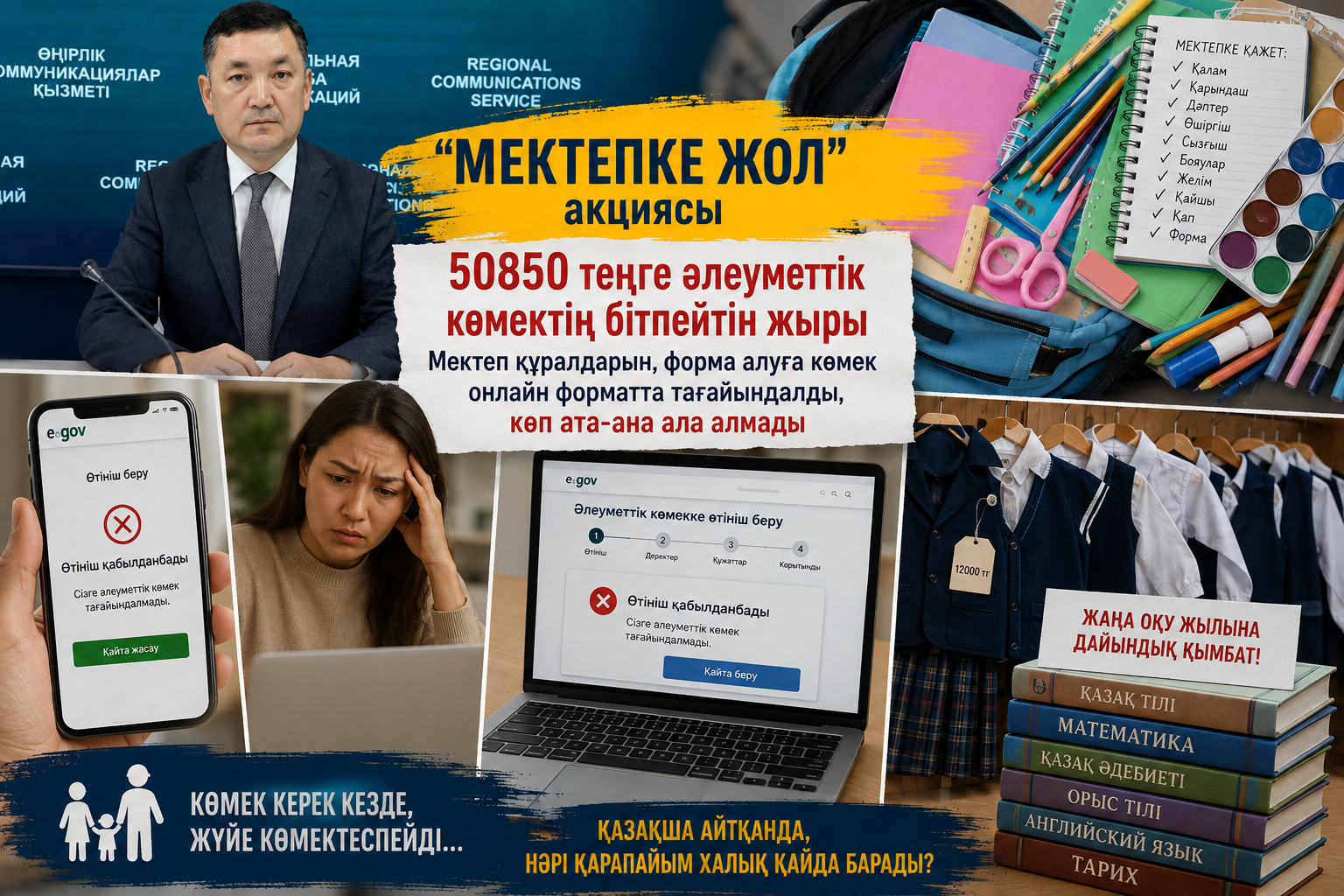
The procedure for determining students eligible for state financial and material assistance has been changed in Shymkent.
Previously, educational institutions themselves determined whether applicants met the established eligibility criteria. The process has now been fully automated. Families’ eligibility is verified through the integration of government information systems, with the required data retrieved automatically from relevant databases.
This was announced by Kuanysh Yskakov, Head of the Shymkent City Education Department.
“Starting this year, applications for financial and material assistance in Shymkent are submitted electronically through the QOSYMSHA information system. Applications are processed digitally, while the family’s compliance with the requirements established by law is verified,” he said.
According to the head of the Education Department, the new system has also identified cases where applicants’ income information did not meet the eligibility requirements. In some cases, the database showed that a spouse of an applicant had earned up to 940,000 tenge over a three-month period. Cases involving the submission of false documents to receive targeted social assistance were also identified at some schools.
Kuanysh Yskakov noted that a number of shortcomings had previously been identified in determining students’ social status at educational institutions. As a result, budget-funded assistance was sometimes granted to children whose families did not actually meet the established criteria.
According to the Education Department, this was one of the reasons why the number of students receiving assistance in Shymkent was significantly higher than in other cities of national significance.
As of now, 78,543 applications have been submitted through the system. Of these, 18,927 are currently under review, while assistance has already been approved for 9,612 applications. A decision to deny financial assistance has been made in 50,004 cases.
The majority of rejected applications involved applicants in the second category — those who do not receive targeted social assistance but whose income is below the subsistence minimum.
Kuanysh Yskakov stressed that the rejections were not caused by a lack of funding.
“Some citizens say that assistance is not being provided because there is not enough funding. That is not the case — the necessary funding is fully available. The key issue here is legal eligibility. Assistance must be provided only to those who are legally entitled to receive it,” he emphasized.
The head of the Education Department also explained that the allocation of financial assistance falls within the authority of schools and is directly the responsibility of the school principal.
At the same time, the city akimat does not interfere in the process of determining eligible recipients or assigning financial assistance.