

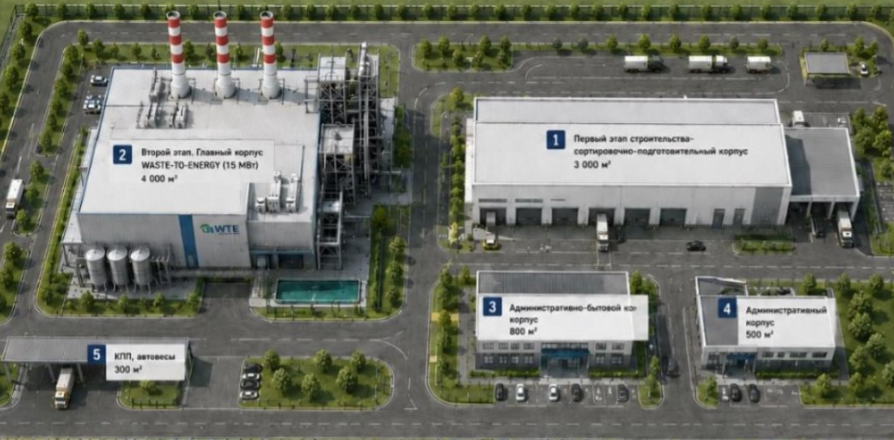
Construction has officially begun on a major solid municipal waste (MSW) treatment and waste-to-energy plant in Kazakhstan’s Zhambyl Region, marking a significant step toward improving waste management and expanding the country’s green energy capacity.
The project involves the construction of a state-of-the-art facility that will process solid household waste and generate electricity from the recovered energy. With a total investment of 80 billion tenge, the development will be implemented in two phases. The first phase is scheduled to become operational in the first quarter of 2027, while the second phase is expected to be completed in the third quarter of 2029.
The facility will utilize advanced waste treatment technologies from South Korea, enabling it to process up to 900 tonnes of municipal solid waste per day and generate up to 20 megawatts (MW) of electricity. The project is expected to significantly reduce the amount of waste sent to landfills while contributing renewable energy to the regional power grid.
The construction phase will create approximately 400 jobs, while the fully operational plant will provide 200 permanent positions, supporting local employment and economic development.
According to project developers, the primary objective is to reduce the environmental impact of municipal waste, promote sustainable waste management practices, and strengthen Kazakhstan’s transition toward a greener economy. The initiative also includes a strong focus on training and enhancing the qualifications of Kazakh specialists, allowing them to work with modern waste-processing technologies.
As part of the national “Taza Kazakhstan” (Clean Kazakhstan) environmental campaign, 1,000 elm saplings are scheduled to be planted at the construction site this autumn, further contributing to environmental restoration and the creation of greener urban spaces.
The new waste-to-energy plant is expected to become one of the largest environmental infrastructure projects in the region, combining modern recycling technologies, renewable energy production, and sustainable development objectives.