

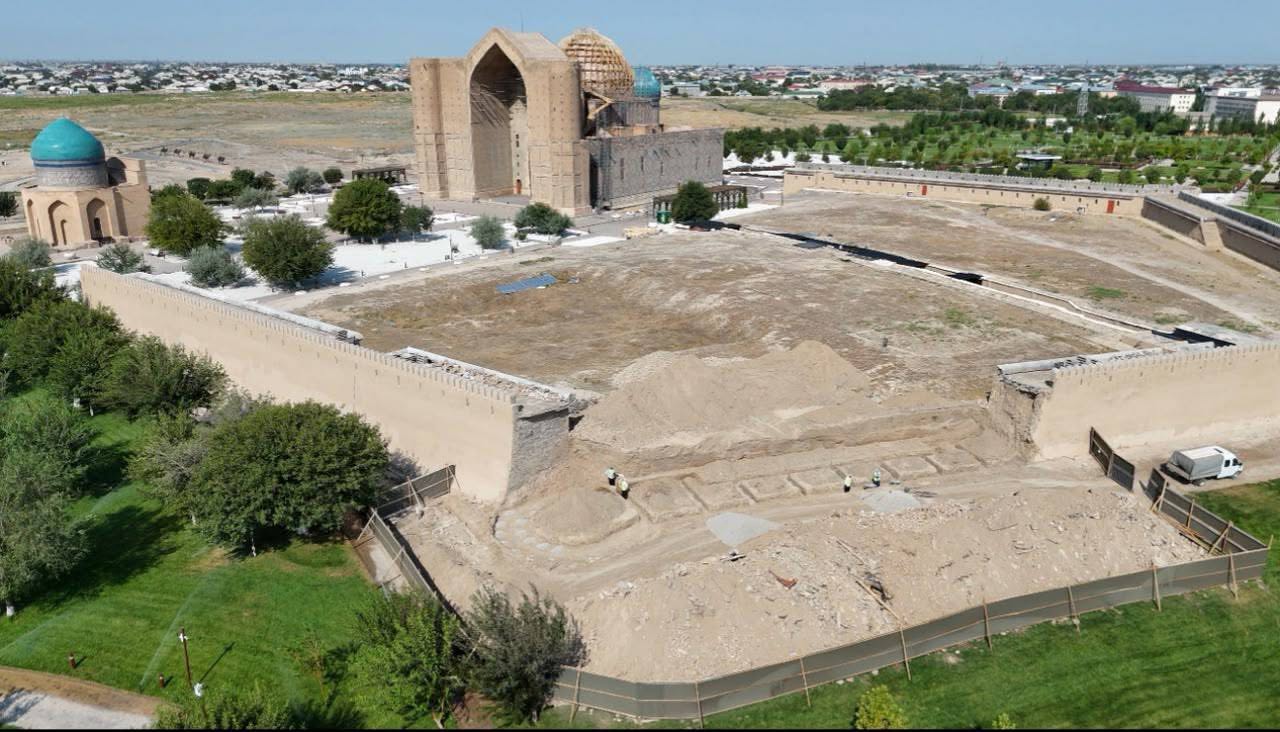
Scientific restoration work has begun on a section of the ancient fortress wall at the historic settlement located near the Mausoleum of Khoja Ahmed Yasawi in the city of Turkistan, Kazakhstan. The project is being carried out by specialists from the state enterprise KazRestoration as part of ongoing efforts to preserve the country’s cultural heritage.
The decision to restore the wall was made following a long-term monitoring program, which revealed that the structure had been shifting by 10–15 centimeters each year, raising concerns about its structural stability and the risk of further deterioration.
The first phase of the project focuses on restoring a 32-meter section extending from the Eastern Gate. In total, the damaged portion of the fortress wall measures 40 meters in length.
The fortress wall was originally reconstructed in the early 2000s based on the findings of archaeological excavations at the ancient settlement. During the current restoration campaign, specialists will reinforce the foundation and rebuild the damaged masonry using suitable original materials recovered from the unstable section, helping to preserve the site’s historical authenticity.
According to the restoration team, the work is expected to prevent further deformation of the wall while maintaining the historic appearance of the northeastern part of the citadel.
The scientific restoration project is scheduled for completion by the end of 2026, contributing to the long-term preservation of one of Kazakhstan’s most significant historical and cultural landmarks.