

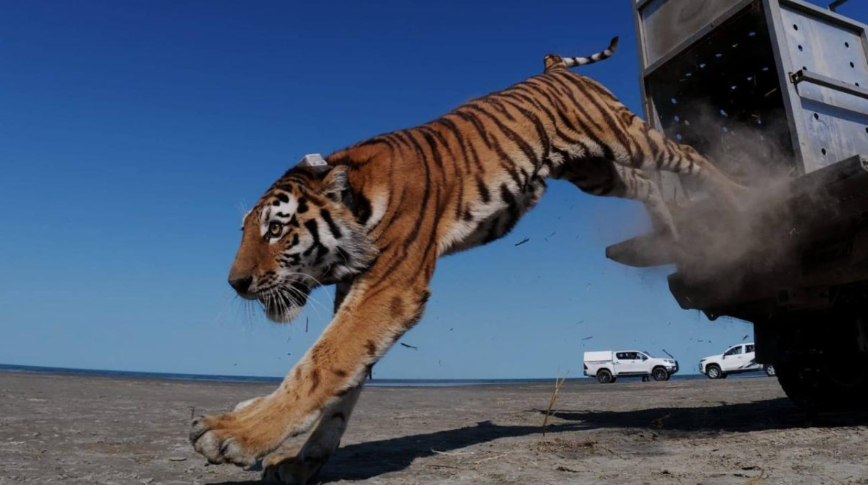
A historic event has taken place in the Ile-Balkhash State Nature Reserve, where an Amur tigress named Ümit has been released into the wild, marking the first return of a tiger to Kazakhstan’s natural environment after the species disappeared from the country more than 70 years ago.
The release of Ümit is the first practical step in a programme aimed at returning tigers to their historical range in Kazakhstan and restoring a sustainable population of the species.
The Ile-Balkhash State Nature Reserve was chosen as the release site for a reason. The southern Balkhash region and the Ili River valley were historically part of the tiger’s natural habitat. The area was once home to the Caspian, or Turan, tiger, one of the largest predators of Central Asia. Its unique tugai forests and abundant food resources provided favourable conditions for the species.
However, by the middle of the 20th century, tigers had completely disappeared from Kazakhstan due to the shrinking of tugai forests, a decline in wild ungulate populations and widespread poaching. The last reliable sightings of tigers in the country were recorded more than seven decades ago.
The programme currently underway is therefore focused on restoring the tiger to its historical habitat. This effort was preceded by large-scale government work to restore the natural ecosystem and create the necessary conditions for the species’ return.
Preparations for the reintroduction of tigers have been ongoing for more than 10 years. During this period, the government established the Ile-Balkhash State Nature Reserve, restored the conditions required for the return of tigers to the wild, increased the population of wild ungulates that serve as the animals’ primary food source, built special enclosures for keeping and adapting the animals, developed the necessary infrastructure and established continuous scientific monitoring.
In May 2026, with the support of the Russian Federation, four Amur tigers captured in the wild were brought to Kazakhstan – two adult animals and two cubs.
Following their arrival, the tigers were placed in specially constructed adaptation enclosures at the Ile-Balkhash State Nature Reserve.
Before her release, Ümit underwent comprehensive veterinary examinations and a series of necessary tests. Specialists assessed her health, behaviour, hunting skills and response to humans. Based on the results, experts determined that the tigress was ready to live independently in the wild.
Immediately before her release, Ümit was fitted with a modern satellite GPS/GSM collar.
The tigress is now under continuous 24-hour monitoring using the satellite collar, a network of camera traps and other modern observation technologies. Specialists track her movements in real time, monitoring her adaptation and exploration of the new territory.
As an apex predator, the tiger plays a crucial role in maintaining the natural balance of ecosystems. Its return is possible only in areas where natural habitats have been preserved and sufficient food resources are available. Therefore, the return of the tiger represents not only the restoration of the species itself but also the recovery of the entire ecosystem of the southern Balkhash region.
The male tiger remains under close observation by specialists and is undergoing the necessary behavioural tests. A decision on his release into the wild will be made after all tests have been completed and his readiness for independent life has been confirmed.
The two tiger cubs, which arrived in Kazakhstan at the age of six to seven months, continue to grow and develop in specially equipped enclosures at the Ile-Balkhash State Nature Reserve.
They will remain under the supervision of specialists until they reach 18 months of age. Following the required veterinary examinations and behavioural tests, a separate decision will be made on whether each cub is ready to be released into its natural habitat.
The project has been made possible through close cooperation between Kazakhstan and Russia, as well as support from international conservation organisations and the scientific community. It represents an example of effective international cooperation in the conservation of endangered wildlife.
The release of Ümit marks the first stage of the practical implementation of the programme to return tigers to their historical range in Kazakhstan. The work will continue as the remaining animals become ready for release.
The ultimate goal of the programme is to establish a sustainable tiger population in the Ili River delta and the southern Balkhash region, restoring one of Central Asia’s most iconic predators to its historical homeland.