

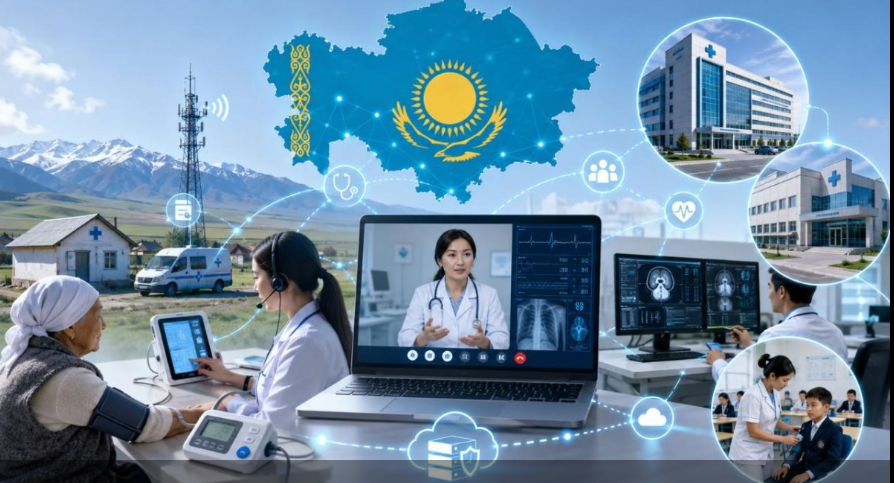
Today, 655 healthcare organizations are connected to telemedicine services, with a potential reach of more than 2 million people. More than 1 million patients have already received telemedicine consultations, confirming the high demand for remote healthcare services.
Telemedicine enables residents of remote regions to receive timely consultations from specialized medical professionals, reduces waiting times for medical care, minimizes the need to travel to regional and national clinics, and ensures continuous patient monitoring in their places of residence. For the first time, a clearly defined list of remote medical services has been established, along with uniform quality and safety requirements for online healthcare services.
In addition, a new order issued by the relevant ministry defines the technologies and equipment to be used in the provision of telemedicine services and expands the conditions under which such services can be delivered.
More Than 4,000 Healthcare Organizations to Join a Unified Telemedicine Network
The next stage of development will involve scaling up telemedicine infrastructure across the country’s entire healthcare system.
In the future, more than 4,000 healthcare organizations are planned to be equipped with modern telemedicine technologies. These will include medical posts, feldsher-midwife stations, medical outpatient clinics, primary healthcare centers, as well as district and regional hospitals.
In addition, modern digital solutions are already being introduced in 72 institutions of the penal enforcement system, providing access to specialized medical care for this category of patients.
The implementation of the project will potentially provide access to telemedicine services for approximately 7.5 million rural residents and establish a unified modern system of remote healthcare delivery throughout Kazakhstan.
Digital Technologies to Transform School Healthcare
The digitalization of school healthcare is one of the Ministry’s priority areas. Telemedicine solutions are planned to be introduced in more than 6,900 schools, covering over 3.6 million students.
The use of digital services will enable preventive medical examinations, remote consultations, health monitoring of children, and more effective prevention and early detection of diseases.
According to data from the Ministry of Healthcare’s information system, since the beginning of the current year, 709 healthcare organizations across all 20 regions of Kazakhstan have provided more than 23.1 million medical services to the population, including over 2.17 million services delivered remotely.
The share of telemedicine services has reached 9.4%, demonstrating the steady development of digital technologies in practical healthcare.
Telemedicine technologies are most actively used in the Aktobe Region (13.66%), the city of Almaty (12.42%), the West Kazakhstan Region (11.04%), the Kyzylorda Region (10.99%), the Karaganda Region (10.95%), the Pavlodar Region (10.62%), and the Turkistan Region (10.00%).
Unified Medical Data Repository to Become the Foundation of the Digital Healthcare Ecosystem
An important area of digital transformation will be the creation of a unified digital healthcare ecosystem.
The initiative envisages integrating information systems of outpatient clinics, hospitals, laboratories, school healthcare services, and telemedicine platforms into a Unified Medical Data Repository, followed by the transfer of consolidated information to the Ministry of Healthcare.
This will enable evidence-based management decisions, improve the efficiency of healthcare administration, ensure continuity of medical care, and create a unified digital healthcare environment.
Today, remote consultations and medical consultations involving multidisciplinary teams remain the most in-demand telemedicine services. At the same time, the Ministry sees significant potential for further development of remote patient monitoring, telemetric electrocardiography, artificial intelligence technologies, and other advanced digital services.
The implementation of a comprehensive set of measures to develop telemedicine will help modernize rural healthcare, ensure equal access to quality medical services regardless of where people live, improve the efficiency of healthcare organizations, and create a modern digital healthcare system focused on the needs of every patient.