

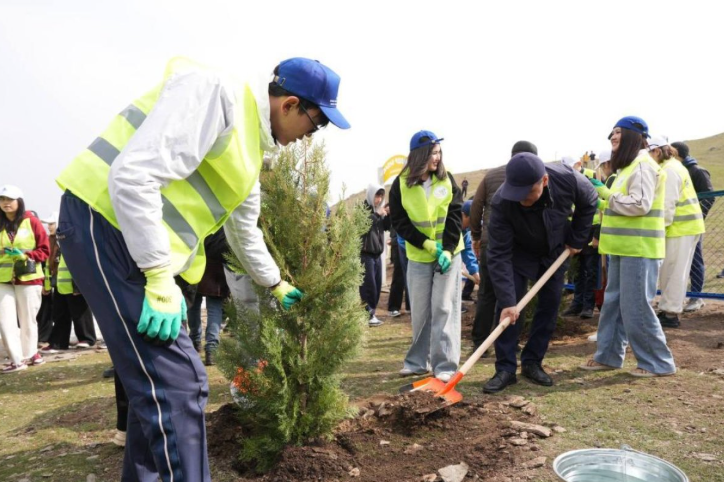
As part of the two-stage nationwide environmental campaign “Möldir Bulaq” (Crystal Spring), held under the “Taza Kazakhstan” (Clean Kazakhstan) initiative launched by the Head of State, cleanup and improvement activities were carried out at springs and the shorelines of water bodies across the country. The first stage took place on March 23, while the second was held on July 11.
As a result, 94 springs and 62 water bodies were cleaned in the regions of Akmola, Aktobe, Almaty, Atyrau, East Kazakhstan, Zhambyl, West Kazakhstan, Karaganda, Kostanay, Kyzylorda, Mangystau, Pavlodar, North Kazakhstan, Turkistan, Abai, Zhetysu, Ulytau, as well as in the city of Shymkent. More than 23,700 people participated in the campaign, including around 3,000 volunteers.
As part of the “Möldir Bulaq” campaign, Kazakhstan also established its first volunteer movement dedicated to the water sector, “Bolashaqtyñ Qainary” (Source of the Future), aimed at promoting environmental awareness among young people. The initiative initially brought together students from the Kazakh National University of Water Management and Irrigation in Taraz. Today, the volunteer movement has expanded to other regions of Kazakhstan.
The volunteer group additionally cleaned five more springs and six shoreline areas of water bodies. More than 3,000 people, primarily young volunteers, took part in these activities.
The “Möldir Bulaq” campaign has received strong public support. In April, volunteers and college teachers in the Kostanay Region organized cleanup events along the banks of rivers and other water bodies. Particular attention was given to the Tobol River, including its riverbanks, embankments, and adjacent park areas.
In May, an environmental cleanup campaign was held along the shoreline of the Aktobe Reservoir, where more than two tonnes of household waste were collected and removed. The Balkhash-Alakol Basin Inspectorate also organized a cleanup of a spring located in the Alma-Arasan Gorge. During the same month, another cleanup campaign took place along the Tobol River in the Kostanay Region, resulting in the collection of three tonnes of waste.