

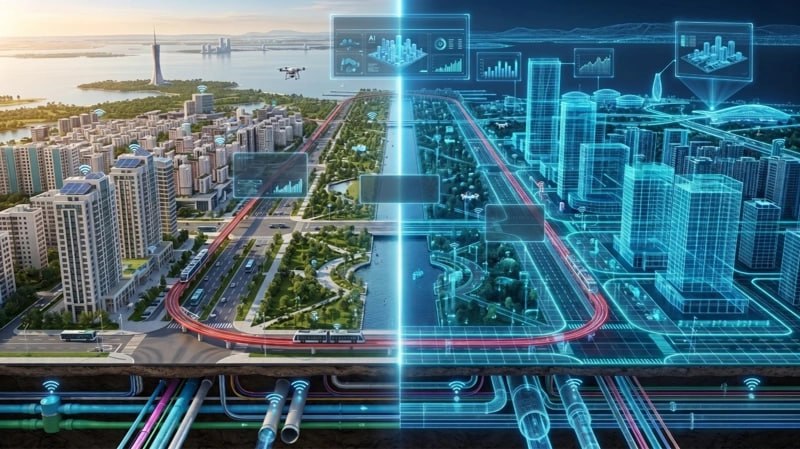
Digital Twins: How Virtual Models Could Transform Kazakhstan’s Cities
Digital twins are becoming one of the key technologies driving the digital transformation of cities, industry, and infrastructure. Already widely used in major metropolitan areas around the world, this technology helps improve governance, reduce costs, and forecast different development scenarios. For Kazakhstan, which is implementing large-scale projects to build new cities and modernize infrastructure, digital twins could become an important tool for sustainable development.
What is a Digital Twin?
A digital twin is a virtual replica of a physical object, territory, or even an entire city. It continuously receives real-time data from multiple sources, including sensors, surveillance cameras, satellites, drones, transport monitoring systems, and municipal service platforms.
Unlike a conventional 3D model, a digital twin is constantly updated. It allows authorities and planners to monitor the current condition of an object, analyze ongoing processes, and simulate future scenarios.
For example, city officials can assess in advance how the construction of a new road will affect traffic flow, identify where congestion may occur, determine how engineering networks will be impacted, or predict which neighborhoods are most vulnerable to flooding during heavy rainfall.
Where Is the Technology Being Used?
Today, digital twins are being adopted by many countries around the world.
China is considered one of the global leaders in this field. In cities such as Beijing, Shanghai, Shenzhen, and others, virtual models help manage transportation, public utilities, construction projects, and public safety systems. By integrating massive volumes of data, local authorities are able to make faster and more accurate decisions.
Similar initiatives have also been implemented in Singapore, South Korea, the United Kingdom, the United Arab Emirates, and Finland.
In the industrial sector, digital twins are used to simulate the operation of factories and production equipment, predict equipment wear, and prevent failures before they occur.
Why Is This Important for Kazakhstan?
For Kazakhstan, the adoption of digital twins could become the next stage in the development of the Smart City concept.
The technology is particularly relevant for large-scale projects such as Alatau City. Creating a digital model during the planning stage allows developers and authorities to understand in advance how transportation systems, utility networks, residential areas, and public spaces will interact.
This approach helps prevent costly mistakes before construction even begins.
Moreover, a digital twin can accompany a city throughout its entire lifecycle—from design and construction to day-to-day operation and future development.
What Can a Digital Twin Do?
The capabilities of digital twins extend far beyond simple visualization.
A digital twin can be used to:
- forecast traffic volumes;
- manage road traffic in real time;
- monitor municipal infrastructure;
- track the condition of engineering networks;
- simulate emergency situations;
- analyze environmental conditions;
- plan the development of new districts;
- optimize energy consumption;
- oversee construction projects.
In practice, all municipal services gain access to a single digital platform that provides up-to-date information about every aspect of city operations.
Economic Benefits
One of the greatest advantages of digital twins is their ability to identify problems before they occur.
While traditional management systems typically respond only after an incident or equipment failure has happened, digital twins can predict potential risks in advance.
For instance, the system can identify sections of a district heating network that are likely to fail or forecast where traffic congestion will develop after a new highway is opened.
This significantly reduces maintenance and repair costs.
Digital modeling also enables governments to allocate public funds more efficiently when constructing new infrastructure.
New Opportunities for Alatau City
Alatau City is regarded as one of Kazakhstan’s most ambitious urban development projects.
Because the city is being developed from the ground up, digital twin technology can be implemented from the very beginning without the need to integrate numerous legacy systems.
Its virtual model could bring together transportation, energy, water supply, environmental monitoring, construction management, and public safety into a single digital ecosystem.
As a result, residents would benefit from more convenient digital services, while city authorities could respond much more quickly to changing conditions.
Challenges Ahead
Despite its clear advantages, implementing digital twins requires significant preparation.
Modern digital infrastructure, high-speed communication networks, extensive sensor deployment, and unified data management standards are essential.
Cybersecurity and personal data protection are equally important, as these systems process enormous volumes of information.
Successful implementation also requires highly qualified specialists in artificial intelligence, big data analytics, geographic information systems (GIS), and urban planning.
Looking Ahead
As artificial intelligence continues to evolve, digital twins are becoming much more than visualization tools—they are developing into intelligent decision-support systems.
In the future, these platforms will be capable of independently forecasting urban infrastructure development, identifying potential risks, and recommending the most effective management solutions.
For Kazakhstan, the adoption of digital twins could become one of the key pillars of its digital transformation, particularly as the country builds new cities and modernizes existing infrastructure. Leveraging international expertise, including China’s experience, could accelerate the deployment of advanced technologies and help create safer, smarter, more sustainable, and more comfortable urban environments.